
How many restrooms does a county fair need?
Start with expected attendance, then work backward. A fair drawing 3,000 people over a weekend day behaves differently than one drawing 3,000 spread across a week, and our placement guide walks through both cases. OSHA 1926.51(c) sets construction-site ratios, not fair ratios, but it's still the closest published benchmark: 1 toilet for every 20 workers scales up in steps as headcount grows. Fair crowds cycle faster than a job site crew, so most organizers in Toms River lean toward the event restroom rental math instead, which runs tighter than the OSHA table.
ADA Standards section 213.2 requires at least 5 percent of a cluster to be accessible units, with a minimum of one no matter how small the cluster is. On a fairgrounds with 20 standard units, that's a full ADA accessible porta potty bank of at least one, and most fairs run two or three to keep wait times down near the accessible line. Add handwashing separate from the units themselves. A handwashing station rental placed near food vendors covers the crowd that a sink built into a toilet unit can't handle alone, and it keeps you square with basic handwashing requirements that fair inspectors tend to check first.
What restroom options work best for a fair?
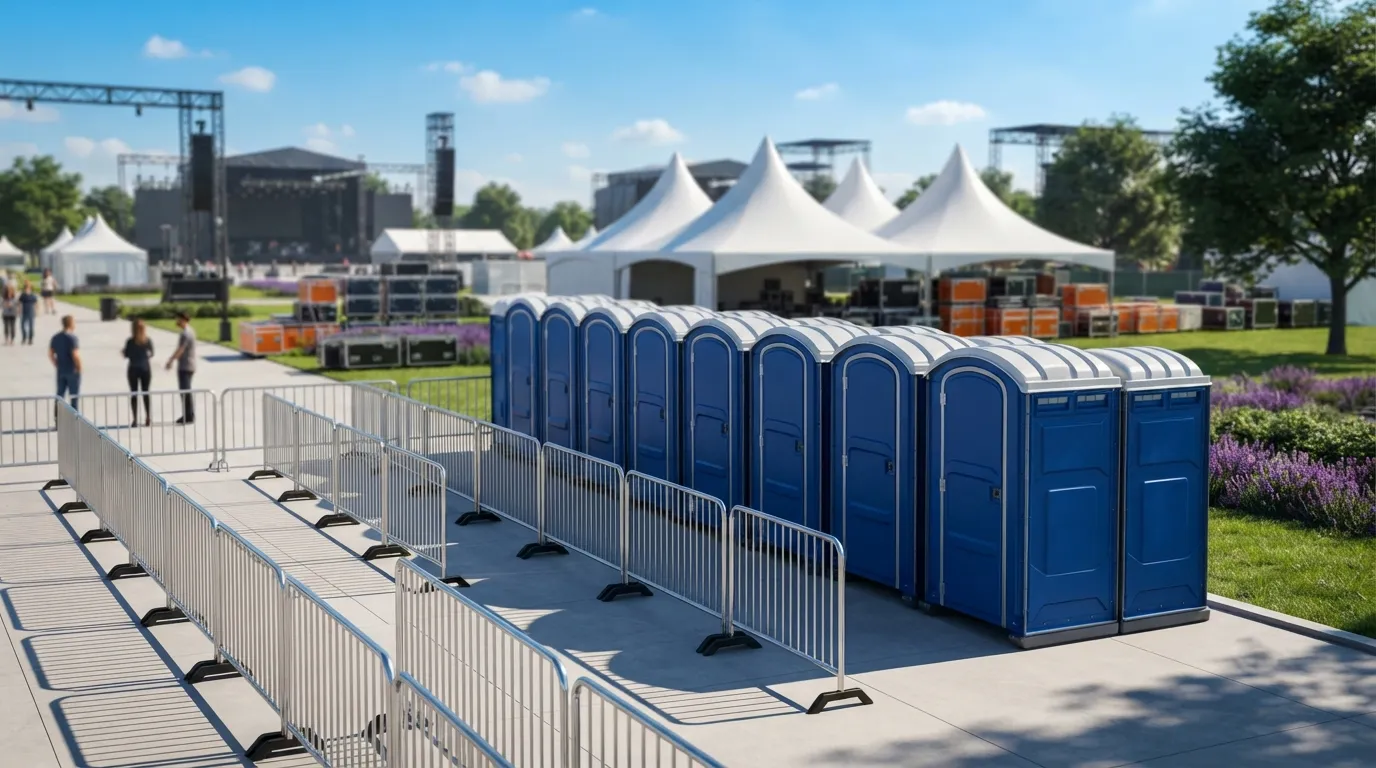
Standard units handle the midway and the parking fields. A standard porta potty rental holds 60 to 70 gallons and stands about 92 inches tall on a 44 by 48 inch footprint, small enough to tuck along a fence line without blocking foot traffic. For anywhere near a stage, a beer garden, or a VIP entrance, step up to a deluxe flushable porta potty or a full restroom trailer rental. A 4 stall restroom trailer handles a steady line better than scattered singles, and an 8 stall restroom trailer is common for fairs running multiple stages at once.
Toms River fairgrounds sites vary in how much flat, level ground they offer, so a walk-through before delivery matters. ADA Standards section 302.1 calls for stable, firm, slip-resistant ground under any accessible unit, and section 405.2 caps ramp slope at 1:12 where a ramp is used. Grass fields that look flat in July can still have enough grade to fail that ramp requirement, so we check before drop-off, not after. If the fair also runs a beer tent or food trucks, pair restrooms with a temporary fence rental to route lines and keep crowd control barrier rental equipment out of walkways.
| unit | day | weekend | week |
|---|---|---|---|
| standard | $100-$350 | $125-$400 | $130-$500 |
| ada | $200-$400 | $199-$300 | -- |
| deluxe | $85-$1,200 | -- | $150-$290 |
Multi-day fair rates typically fall under the standard "event" pricing band rather than a plain daily rate, running $200 to $800 depending on unit count and service level. A request a quote conversation is the fastest way to pin down which band your fair lands in.
Why do fairs need more service visits than a normal rental?
Because the volume of use compresses into a few long days instead of spreading across a month. ANSI/PSAI Z4.3 sets a baseline service interval of once a week for up to 10 users over a 40-hour week, and a fairgrounds blows past that ratio in a single afternoon. That means service trucks may need to hit the site mid-event, not just before and after. Toms River Porta Pros schedules servicing around gate hours so a truck isn't rolling through the midway during peak foot traffic.
Delivery access matters too. A roll-off or restroom trailer generally needs about 60 feet of straight clearance behind the truck to place safely, which rules out some tighter fairground entrances unless a secondary gate is opened for service vehicles. If your fair also runs food vendors producing fryer waste, ask about a grease trap pumping plan alongside the restrooms, since grease interceptors get pumped once they hit 25 percent fats, oils, and grease by liquid depth. For fairs near Toms River, Berkeley sits 7.7 miles south and is worth checking if your event footprint crosses township lines, since porta potty rental in Berkeley service overlaps our normal routes. Manchester, 14.2 miles west, and Howell, 14.9 miles north, fall within range for combined bookings if your fair partners with vendors from those towns.
How far in advance should we book restrooms for a fair?
Book 6 to 8 weeks out for anything over 500 expected attendees. Fair season compresses demand across Toms River and nearby towns at once, so trailers and ADA units book first. A request a quote call early locks equipment before smaller weekend events absorb the fleet.
Do we need handwashing stations separate from the restroom units?
Yes, especially near food vendors. 29 CFR 1910.141(d)(2) requires soap and towels or a hand-drying device, not sanitizer alone. A portable sink rental placed at food court entrances covers this cleanly.
Can restrooms be serviced mid-event without disrupting the fair?
Yes. We schedule service trucks around published gate hours and use rear or secondary access points. Multi-day fairs usually need at least one mid-run service pass beyond the standard weekly interval.
What size restroom trailer fits a two-day county fair?
Depends on attendance. A 2 stall restroom trailer suits smaller community fairs under a few hundred daily visitors, while a 4 stall or 8 stall trailer fits larger multi-day draws with concurrent stages.
Does the fairgrounds need a permit for restroom placement?
Placement in a public right of way needs confirming with the city. Fairgrounds on private or township-owned land may have separate rules, so check with the venue and review our porta potty permit requirements page before finalizing layout.
Next step
Get a delivery date
Tell us the address, the dates and the headcount. We size the order and confirm the route.